




Paradise Hills is a residential neighborhood in the central Las Vegas Valley with a character that’s distinctly more community-oriented than its proximity to the Strip corridor might suggest. The neighborhood’s housing stock, primarily developed from the 1970s through the 1990s, represents a generation of Las Vegas growth that predates modern HVAC efficiency standards. Many of the AC systems in Paradise Hills are either original equipment approaching the end of their practical life or first-generation replacements that are themselves aging into the repair-or-replace conversation. Century AC & Heating Repair has served this part of the valley since 1997 and knows these homes well.
Paradise Hills sits in a zone that experiences the compounding heat effect of both urban density and long daily sun exposure with limited shade from mature trees in many blocks. AC systems here have to perform through long, hard summers with minimal recovery time overnight.


Paradise Hills homes require a diagnostic mindset that accounts for equipment age, installation history, and the cumulative effects of years of desert operation. Our technicians approach each call knowing that what presents as a simple symptom in an older system is often the visible end of a longer deterioration process.
We inspect thoroughly and ask the right questions: how long has the system been running, when was the last service, have there been prior repairs, what’s the duct configuration. These details shape our diagnostic approach and help us give you a recommendation that actually addresses the problem and not just its most recent expression.
After the inspection, we give you our honest assessment. If the repair makes sense given the system’s age and condition, we’ll tell you that. If the system is at a point where further repair investment isn’t in your best interest, we’ll tell you that too. Our job is to give you real information, not to close a transaction.
Aging housing stock and long summers create a predictable set of warning signs in Paradise Hills. These are the most common ones we hear about.
In a neighborhood with a lot of older equipment, these signs often reflect the cumulative wear of multiple seasons rather than a single acute failure. The earlier you call, the more options you have.

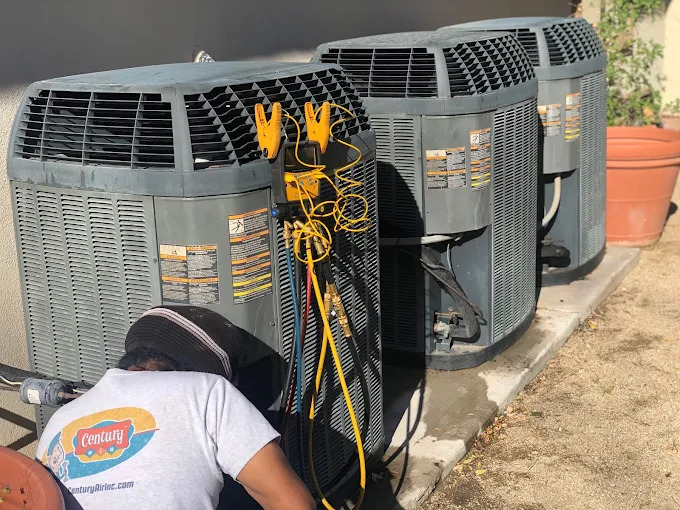
The homes in Paradise Hills are characterized by the construction standards of the 1970s and 1980s, a period when insulation requirements were lower, window glazing was less efficient, and duct systems were built for durability rather than energy performance. Original ductwork in these homes typically runs through unconditioned attic space that reaches extreme temperatures in summer, and the duct insulation from that era has often degraded to the point where significant heat gain is occurring on the supply side before air even reaches the living space.
Many Paradise Hills homes also feature older wood-frame construction with settled and shifted foundations, and duct connections that were once tight have often developed gaps over decades of movement and thermal expansion. Homeowners in these properties frequently notice that the system runs hard but rooms still feel warm, and the culprit is often as much duct performance as equipment condition.
The central valley location also means Paradise Hills deals with the ambient temperature effects of surrounding commercial development and road surfaces. Outdoor AC equipment here operates in higher ambient temperatures than valley-edge communities, which stresses compressors and reduces the efficiency of refrigerant heat rejection during peak afternoon hours.
A homeowner named Frances called us last June from her home near Twain Avenue, describing a system that had always run fine but seemed to be struggling more each summer. She’d had the same equipment for about 16 years and had done minimal maintenance because it had never caused serious problems.
Our technician found a combination of factors: a condenser coil coated with years of dust and debris, a capacitor testing at the low end of acceptable range, and a condensate line with partial blockage from scale buildup. None of these issues alone would have caused a complete failure that day, but together they were responsible for the declining performance Frances had been noticing. We addressed all three, and she described the improvement as like getting a new system without paying for one. That’s the kind of outcome proper maintenance produces, and the reason we talk about it on every call.

A neighborhood like Paradise Hills, with its history and its aging homes, deserves a service company that takes older equipment seriously and doesn’t just push replacements to avoid the work. We’ve been doing the work in homes like these for nearly 30 years and we’re committed to getting the most out of a system when that’s the right answer and being honest when it isn’t.
Our family-owned approach means we make recommendations based on what’s right for the homeowner, not what maximizes our revenue. That’s a distinction that matters, and it’s why people in Paradise Hills keep calling us back.